
X-ray apron testing - DIN 6857-2
Prüfung vor Ort
Röntgenschürzen-Prüfung bei Ihnen in der Klinik
Service steht bei uns im Mittelpunkt. Wir prüfen Ihre Röntgenschutzkleidung nach DIN 6857-2 mit unserer eigenen Röntgenanlage direkt in Ihrer Einrichtung, mit digitaler Inventarisierung und revisionssicherem Prüfbericht, auf Wunsch auch am Wochenende.
Ihr Ansprechpartner: Oliver Ernst
- Eigene Röntgenanlage Wir prüfen mit unserer eigenen mobilen Anlage direkt bei Ihnen vor Ort
- Auch am Wochenende Termine, wie immer Sie es sich wünschen
- 250–300 Teile pro Tag, mit Röntgenbild je Schürze und Prüfbericht
- Jährlich Unsere Empfehlung: Durchleuchtung jährlich, so wird auch die Tastprüfung mit abgebildet
Schürzen aussortiert?
Ersetzen Sie sie günstig mit dem Trade-In-Preis. Ab 10 Stück erstellen wir Ihnen ein individuelles Angebot mit besonders günstigen Trade-In-Konditionen.
Trade-In-Preis anfragenDIN 6857-2 - Testing and inventory of X-ray aprons (RFID)
This page gives you an overview of what is important when checking X-ray aprons according to DIN 6857-2 and what is possible according to the latest state of the art.
Here are the most important keywords on the subject of X-ray apron testing at a glance:
-
Visual and functional testing of X-ray aprons
-
Tactile testing of X-ray aprons
-
Testing the X-ray apron with X-ray radiation
-
Logging and inventorying of X-ray aprons
So läuft die Prüfung bei Ihnen ab
Vier Schritte, von der Terminabsprache bis zum revisionssicheren Prüfbericht. Wir empfehlen die Durchleuchtung jährlich, damit auch die Tastprüfung mit abgebildet wird.
-
Termin und Organisation
- Terminvereinbarung im Vorfeld, auch am Wochenende
- Prüfleistung ca. 250–300 Teile pro Tag
- Möglichst wenige Standortwechsel, idealerweise nur alle 2–3 Tage
- Ihr Personal transportiert die Schürzen zum Prüfort und zurück
-
Mobile Röntgenanlage
- Prüfung mit unserer eigenen Röntgenanlage, ein Vollschutzgerät: keine zusätzlichen Strahlenschutzmaßnahmen nötig
- Anzeige bei der zuständigen Stelle durch uns
- 487 × 130 × 162 cm, ca. 360 kg, passt durch normale Türen und Aufzüge
- Kompakter Prüfbereich mit Anlage, Computerarbeitsplatz und Arbeitstischen
-
Inventarisierung und Prüfung
- Digitale Erfassung jeder Schürze (deutsche Cloud, DSGVO-konform)
- Dauerhaftes Label und RFID-Tag
- Bleigleichwert, Hersteller und Typ werden erfasst
- Einzelbewertung: bestanden, bestanden mit leichten Mängeln oder defekt
-
Ergebnis und Dokumentation
- Digitale Röntgenbilder jeder geprüften Schürze
- Detaillierter Prüfbericht
- Bild, Inventarnummer, RFID-Tag und Ergebnis eindeutig zugeordnet
- Defekte Schürzen verbleiben bei Ihnen, Sie entscheiden über das weitere Vorgehen
Preise der Röntgenschürzen-Prüfung
Alle Preise pro Stück zzgl. Umsatzsteuer.
-
Krankenhaus in Deutschland
pro Stück, ab 50 Stück, zzgl. Umsatzsteuer
14,99 €
-
Krankenhaus in Österreich
pro Stück, ab 100 Stück, zzgl. Umsatzsteuer
14,99 €
-
Krankenhaus in der Schweiz
pro Stück, ab 100 Stück, zzgl. Umsatzsteuer
CHF 17,50
-
Prüfung bei uns in Karben
pro Stück, zzgl. UmsatzsteuerDie Röntgenschürzen müssen zu uns geschickt werden.
25 €
Der Artikel „Röntgenschürzen Prüfung (bei Ihnen)“ weiter unten im Shop (17,84 € inkl. MwSt.) entspricht dem Preis von 14,99 € netto pro Stück. Für ein Angebot zu Ihrer Stückzahl nutzen Sie bitte das Kontaktformular.
Preis für Ihre Prüfung berechnen
Wählen Sie den Prüfort, tragen Sie Ihre Stückzahl ein und sehen Sie sofort Ihren Preis. Auf Wunsch erstellen wir Ihnen ein Angebot für einen Rahmenvertrag. Ihre Anfrage senden Sie danach über das Kontaktformular.
Contact form
What does MD Solutions offer you regarding X-ray apron testing?
-
X-ray apron testing for hospitals
-
X-ray apron testing for field staff
-
RFID tags for X-ray aprons
-
Software solution for managing X-ray aprons

MD Solutions GmbH - Strahlenschutz
X-ray apron testing (at your location)
Share
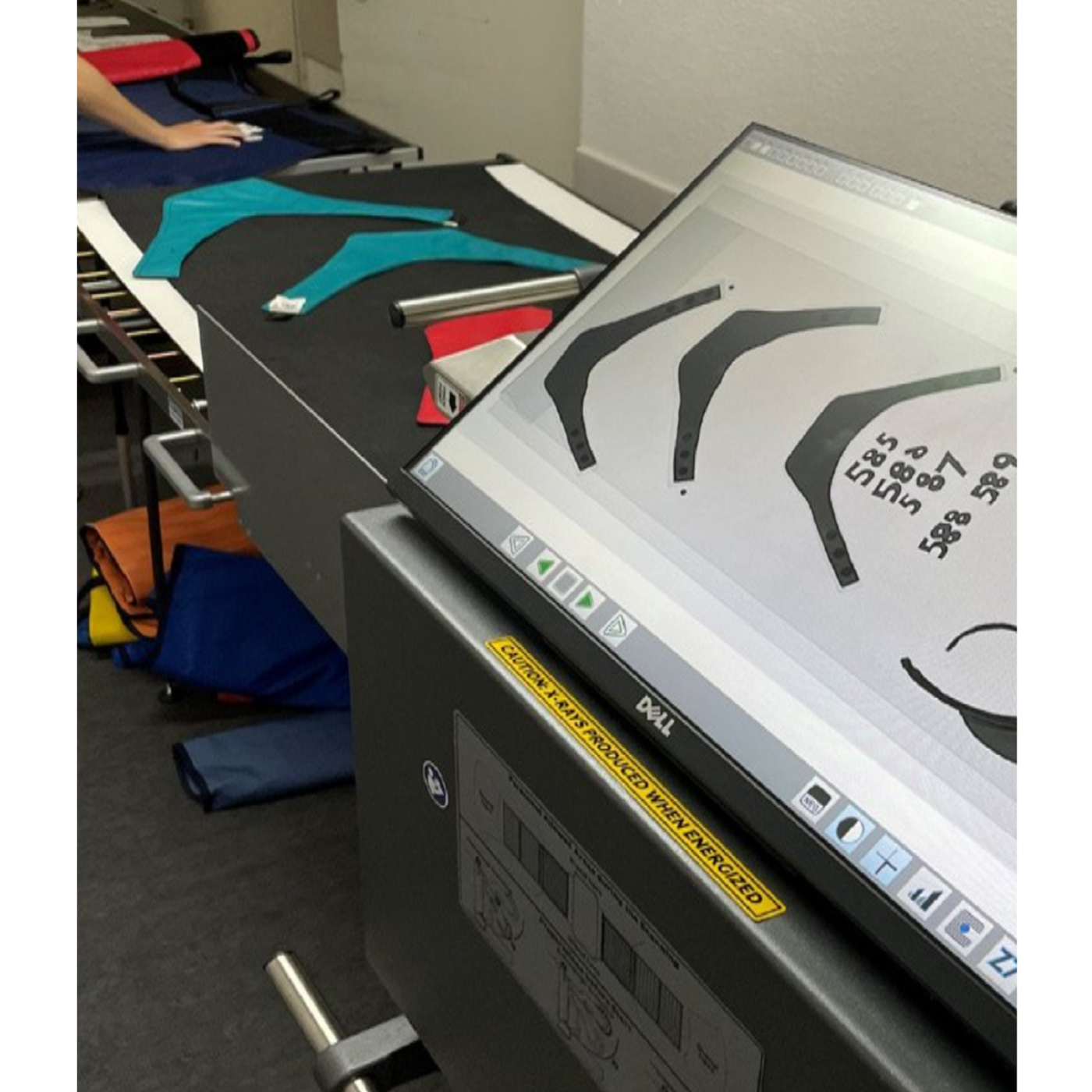
Inspection and inventory of your X-ray aprons according to DIN 6857-2

What should be considered when testing X-ray protective clothing according to DIN 6857-2?
At MD Solutions, we would like to provide you with an overview of the criteria that are important when inspecting an X-ray apron according to the currently valid DIN 6857-2:2021-0 standard. We would be happy to assist you in inspecting your X-ray protective clothing:
-
Visual and functional test
How often should the visual and functional test of an X-ray apron be performed?
According to DIN 6857-2:2021, a visual and functional test of the X-ray apron must be carried out every working day before use.
What should be taken into account during the visual and functional inspection?
Outer shell
- Are the seams intact?
- Can the locking elements be closed?
Protective material
- Are there any bulges at the hem?
- Do fragments collect in the seam?
-
Tactile test
How often should a tactile inspection of the X-ray apron be carried out for mechanical damage to the protective layer?
The tactile inspection of the X-ray apron must be performed at least annually. The actual inspection cycle depends on the age and frequency of use of the X-ray apron.
What should I pay attention to?
Protective material
- Has any part of the protective material collapsed?
- Are there any breaks/kinks in the protective material?
- Does the protective material have cracks/holes?
-
Testing with X-rays
How often should the X-ray apron be checked with X-rays?
Immediately if damage is suspected
If damage is suspected after the visual and functional test or the tactile test, the X-ray apron must be inspected immediately.
New X-ray aprons after 3 years
For new X-ray protective clothing, testing with X-ray radiation must be carried out no later than 3 years after the start of use.
Older X-ray aprons every 2 years
If no damage was found during the initial inspection of the X-ray apron, a re-inspection is required after 2 years.
Damaged X-ray aprons every year
If damage is detected, the inspection cycle of the X-ray apron must be reduced to 1 year.
When is an X-ray apron defective (faulty)?
If there is a suspicion that the protective properties of the protective material are impaired by the visual, functional or tactile test, the X-ray test should be carried out immediately.
When does an X-ray apron show defects according to DIN 6857-2?
The apron is considered defective (protective effect impaired) and may no longer be used as soon as:
- the apron's fastening elements can no longer be closed , meaning the apron cannot be worn correctly on the body.
- the protective material has defects / flaws such as cracks or holes .
The responsible radiation protection officer must determine whether a tear in the protective material means that the X-ray apron is defective or faulty. A defect is damage that leads or could lead to a significant reduction in the protective effect or functionality of the X-ray apron.
We have dedicated a separate section to this topic, which you will find below.
Switzerland – Inspection of X-ray protective clothing according to Article 24 of the X-ray Ordinance
In Switzerland, the Federal Office of Public Health (FOPH) requires an annual inspection of the functionality of protective equipment (X-ray protective clothing). We at MD Solutions GmbH are happy to assist you in Switzerland with checking the functionality of your protective equipment.
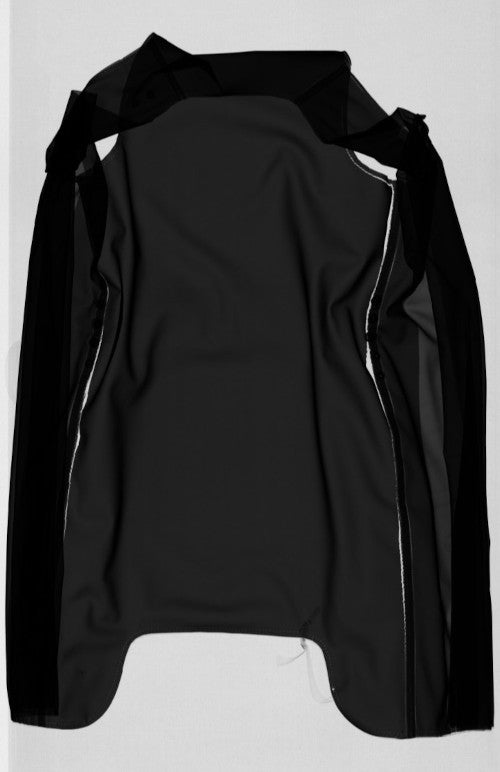
Exclusion criteria for the inspection of radiation protective clothing
When inspecting radiation protective clothing, we developed a template that gives us an indication of which aprons need to be discarded and which can be reused. The criteria are taken from a 2001 scientific paper by K. Lambert and T. McKeon entitled "Inspection of Lead Aprons: Criteria for Rejection." In this paper, they examined defects in X-ray aprons and developed criteria for rejecting an apron.
All defects that add up to ≥ 16 mm² (small square in the magnifying glass on the right) or have an edge length > 15 mm are considered defective and will be rejected.
The enlarged section of the apron shows the template on the left and the defect (white) on the right. As can be seen, the small square would not completely cover the inclusion (≥ 16 mm²).
DIN 6857-2:2021-04 does not provide a clear definition of when an X-ray apron is considered defective. We have chosen the above-mentioned decision criteria for our own purposes.
If you have any further questions or suggestions, please contact us ( click here ).
X-ray apron testing - software solution
We have developed a software solution for X-ray protective clothing inspections that allows you to quickly and easily identify the X-ray protective clothing that needs to be inspected. We offer an inventory and audit of your X-ray protective clothing inventory. Using a database, we record your entire X-ray apron inventory. Our solution also features a mobile RFID scanner that provides you with information about your X-ray apron inventory. This solution enables you to efficiently and cost-effectively monitor your inventory in accordance with DIN 6857-2:2021-04.
Your benefits at a glance:
-
Reduction of verification effort
-
Inventory of X-ray protective clothing
-
Audit-proof review of the inventory
-
Localization of the inventory
DIN 6857-2 provides clear guidelines for recording the test results of X-ray protective clothing:
- Damage and defects to X-ray protective clothing must be recorded
- X-ray and CT scans do not need to be archived
- An inventory list should be kept to prove that all protective clothing in use has been tested
With the help of our software solution for audit-proof monitoring of your current inventory, you can easily monitor DIN 6857-2.
Our software solution is available in four different packages:
-
Unlimited
This package is a complete, worry-free solution. It includes the software package and X-ray apron testing. We take over inventory management of your X-ray aprons, and the process is automated for you.
-
Essential
This software package manages up to 500 X-ray aprons and enables quick and easy inspection tracking. The RFID handheld reader is also included in the rental price.
-
Basic
This software package manages up to 500 X-ray aprons and enables quick and easy inspection tracking.
-
Starter
Free starter pack up to a size of 25 x-ray aprons.
So arbeiten Datenbank, Scanner und Schürze zusammen
Jede Röntgenschürze erhält einen RFID-Chip. Der Scanner liest ihn aus und gleicht die Daten mit der Datenbank ab.
Datenbank
- Datenbank zur Erfassung aller Röntgenschürzen
- Erfassung neuer Röntgenschürzen
- Schnittstelle zur Erfassung der Daten vom Lieferanten
RFID-Scanner
- Erfassung Röntgenschutzkleidung
- Inventarisierung
- Erfassung der letzten Überprüfung
- Schnittstelle zur Datenbank
Röntgenschürze
- Alle Röntgenschutzkleidungsstücke werden mit einem RFID-Chip ausgestattet
- Eineindeutige Zuordnung des jeweiligen Bauteiles
Implementation of the software solution – X-ray apron inspection and inventory
For the implementation of our software solution for the inspection of X-ray aprons, we will present the solution to you in a preliminary discussion and determine a path for implementation.
-
Software solution – preliminary discussion
Complete inventory / on-site comparison with the information you provide regarding X-ray protection (number of X-ray aprons, thyroid protection, etc.)
Needs analysis for the inventory system
- Number of annual reports
- Documentation effort
-
Software solution – implementation
Installation
Inventory of existing X-ray aprons
Each piece of X-ray protective clothing receives an RFID chip
The RFID chip enables:
- Quick identification of the garment
- Comparison of the place of use
- Assignment of images from the last review
-
Software solution – operation
Mobile RFID scanner for quick status query
Regular status reports
Current location
Next review date
Number of garments in stock
Häufige Fragen zur Röntgenschürzen-Prüfung
Stand: 31. Oktober 2026. Ansprechpartner: Oliver Ernst, Telefon 06039 5653.
Wie oft muss Röntgenschutzkleidung geprüft werden?
Nach DIN 6857-2 gilt: arbeitstäglich eine Sicht- und Funktionsprüfung durch den Anwender, mindestens jährlich eine Tastprüfung und eine Durchleuchtungsprüfung mit Röntgenstrahlung. Neue Schürzen werden erstmals nach 3 Jahren geprüft, ohne Mängel danach alle 2 Jahre, bei leichten Mängeln jährlich. Bei erheblichen Schäden wird die Schürze sofort ausgesondert. Wir empfehlen die Prüfung mit der Durchleuchtung jährlich, damit auch die Tastprüfung mit abgebildet wird. Nach DIN 6857-2 ist ohne Mängel auch ein 2-Jahres-Intervall möglich, das stimmen wir mit Ihnen ab.
Wie läuft die Prüfung in unserer Klinik ab?
Wir vereinbaren vorab einen Termin und richten vor Ort einen kompakten Prüfbereich mit unserer eigenen mobilen Röntgenanlage, Computerarbeitsplatz und Arbeitstischen ein. Jede Schürze wird digital inventarisiert, erhält ein dauerhaftes Label und einen RFID-Tag und wird einzeln mit Röntgenstrahlung geprüft. Ihr Personal transportiert die Schürzen zum Prüfort und zurück in die Abteilungen.
Wie viele Röntgenschürzen schaffen Sie pro Tag?
Unsere Prüfleistung liegt bei etwa 250 bis 300 Teilen pro Tag. Damit der Ablauf effizient bleibt, planen wir möglichst wenige Standortwechsel innerhalb der Klinik, idealerweise nur alle 2 bis 3 Tage.
Prüfen Sie auch am Wochenende?
Ja. Service steht bei uns im Mittelpunkt: Wir richten uns nach Ihrem Betrieb und prüfen auch am Wochenende, wie immer Sie es sich wünschen. Den Termin stimmen wir im Vorfeld mit Ihnen ab.
Welche Strahlenschutzmaßnahmen sind bei der Prüfung nötig?
Keine zusätzlichen. Wir prüfen mit unserer eigenen mobilen Röntgenanlage, ein Vollschutzgerät, und wird für die Prüfung bei der zuständigen Stelle angezeigt. Sie ist 487 cm lang, 130 cm breit, 162 cm hoch, wiegt ca. 360 kg und passt durch normale Türen und Aufzüge.
Was erhalten wir nach der Prüfung?
Sie erhalten digitale Röntgenbilder jeder geprüften Schürze und einen detaillierten Prüfbericht. Bild, Inventarnummer, RFID-Tag und Prüfergebnis sind eindeutig zugeordnet, damit haben Sie eine revisionssichere Dokumentation. Jede Schürze wird bewertet als bestanden, bestanden mit leichten Mängeln (verkürztes Prüfintervall) oder defekt (Aussortierung erforderlich). Defekte Schürzen verbleiben bei Ihnen, über das weitere Vorgehen entscheiden Sie.
Was kostet die Röntgenschürzen-Prüfung?
Im Krankenhaus in Deutschland kostet die Prüfung ab 50 Stück 14,99 € pro Stück zzgl. Umsatzsteuer, in Österreich ab 100 Stück ebenfalls 14,99 € pro Stück. In der Schweiz kostet sie ab 100 Stück CHF 17,50 pro Stück zzgl. Umsatzsteuer. Bei uns in Karben prüfen wir für 25 € pro Stück zzgl. Umsatzsteuer, die Röntgenschürzen müssen dafür zu uns geschickt werden. Im Konfigurator auf dieser Seite sehen Sie Ihren Preis sofort.